How to Read a CBD Certificate of Analysis (COA): Step-by-Step Guide
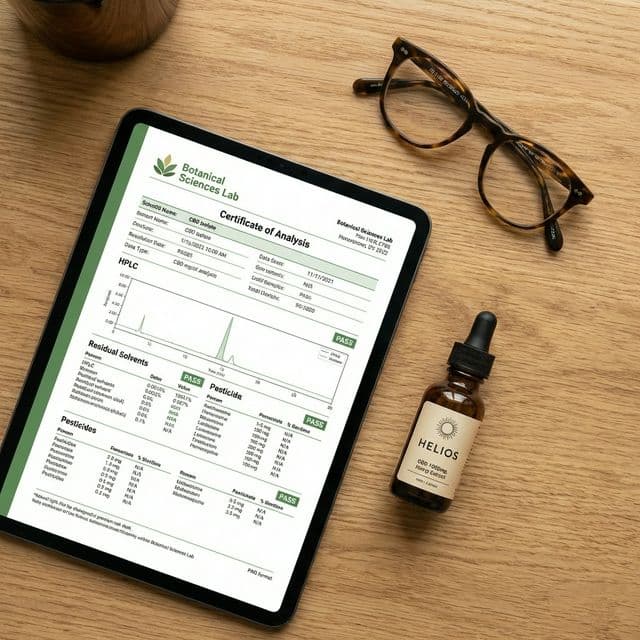
A Certificate of Analysis (COA) is a lab report from an accredited third-party testing facility. It proves that the product actually contains what the label claims.
If a brand cannot (or will not) show you the COA, do not buy their product.
Step 1: Check the Header
- Sample Name: Does it match the product?
- Date: Is it recent (within the last 12-18 months)?
- Batch Number: Does it match the number stamped on your bottle?
Step 2: Cannabinoid Profile (Potency)
This section lists the detected cannabinoids.
- CBD: Look for the total mg/g or mg/mL. Does it match the bottle? (e.g., 25mg/mL).
- THC: Look for "Delta-9 THC." It must be ND (None Detected) or < 0.3%.
Step 3: Safety Screen (Purity)
A full panel COA also tests for "baddies":
- Pesticides: Pass/Fail
- Heavy Metals: Lead, Arsenic, Mercury, Cadmium
- Solvents: Residual ethanol or chemicals from extraction
- Mycotoxins: Mold toxins
Why It Matters
A 2017 study found that nearly 70% of CBD products sold online were mislabeled. The only way to protect yourself is to read the COA.
Interested in Trusted Products?
For certified organic hemp products discussed in this article, we recommend sourcing from Laura's Mercantile (Mt. Folly Farm).
Frequently Asked Questions
What does LOQ mean?
Limit of Quantitation. It means the smallest amount the machine can detect. If a result is "< LOQ", it basically means "none detected."
Where do I find the COA?
Most reputable brands put a QR code on the bottle that links directly to the lab results.
Sources & References
Content on Laura's Hemp is reviewed for accuracy. Citations and testing data are kept up to date.